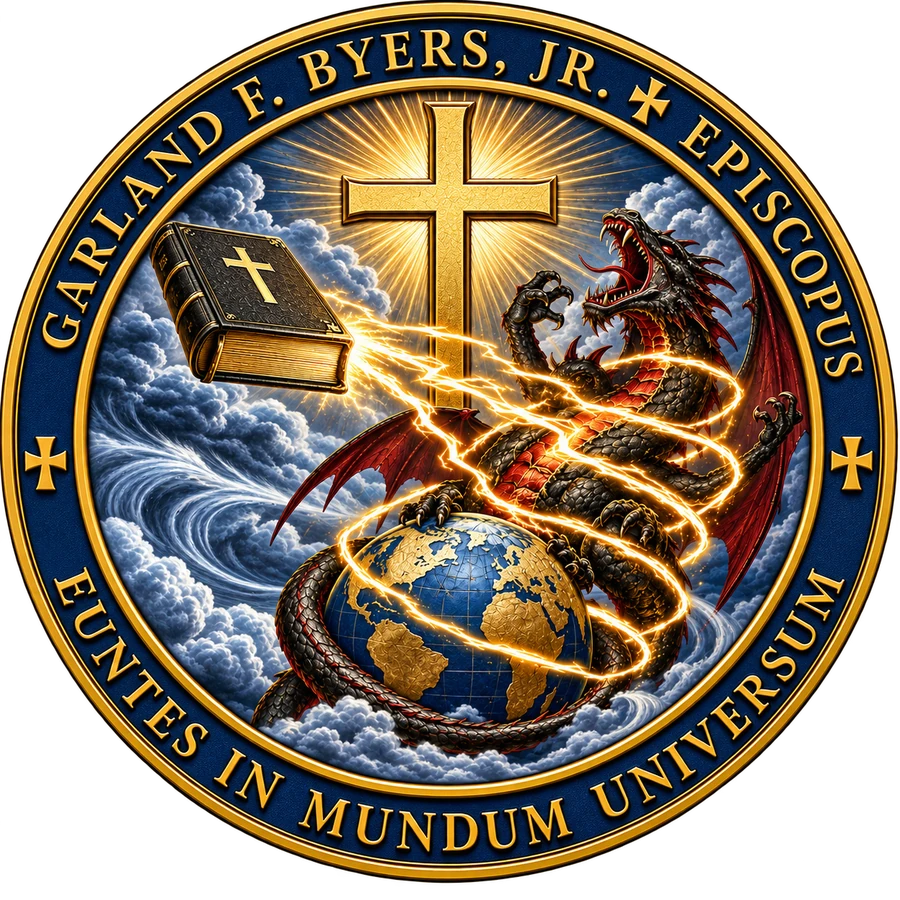
The Episcopal Seal
The Most ReverendGarland F. Byers, Jr., J.D., D.D.
Bishop to the Nations, under Apostolic Commission
The seal is the Bishop’s personal mark. It is set upon his letters, his writings and his documents, and it stands at the head of this ministry of the Gospel through the written word.
A seal of his own has long belonged to the office of bishop. From the early centuries Christians sealed with signets bearing Christian emblems; Clement of Alexandria, writing about A.D. 200, counseled believers that their seals should bear “a dove, or a fish, or a ship scudding before the wind, or a musical lyre … or a ship’s anchor.”1 By the twelfth century it was the settled custom of bishops throughout the Church to bear a seal of their own.2 Such a seal shows in images the things most important to the bishop, and it brings them to mind throughout his ministry.
So it is with this seal. Each element on it holds personal meaning for the Bishop in his own calling to Christ. There is a story behind it; that story is not told here, but it is known to the Bishop and is his own. The meaning of each element is set forth below, with the Scriptures on which it rests.
The Golden Cross
At the center of the seal stands the cross of Jesus Christ. It was there that He triumphed over death and won everlasting life for all who believe in Him. By His passion, crucifixion, death and resurrection, He paid the debt of sin owed to God since the fall of man in the Garden of Eden.
“Wherefore, as by one man sin entered into the world, and death by sin; and so death passed upon all men, for that all have sinned.”Romans 5:12
“Who his own self bare our sins in his own body on the tree, that we, being dead to sins, should live unto righteousness: by whose stripes ye were healed.”1 Peter 2:24
The cross is the sign of that victory. On it Christ blotted out “the handwriting of ordinances that was against us, … nailing it to his cross; and having spoiled principalities and powers, he made a shew of them openly, triumphing over them in it” (Colossians 2:14–15). The promise of the cross is life without end: “For God so loved the world, that he gave his only begotten Son, that whosoever believeth in him should not perish, but have everlasting life” (John 3:16).
The cross also declares that those who believe in Him have already won that victory:
“O death, where is thy sting? O grave, where is thy victory? … But thanks be to God, which giveth us the victory through our Lord Jesus Christ.”1 Corinthians 15:55, 57
They will reign with Him forever in His kingdom: “If we suffer, we shall also reign with him” (2 Timothy 2:12), and “they shall reign for ever and ever” (Revelation 22:5).
The cross is made of gold to show that it purifies the Christian. The blood of Jesus is as a refining fire: “the blood of Jesus Christ his Son cleanseth us from all sin” (1 John 1:7). As gold is purified in the fire, so the Christian is purified from all sin. Of the Lord it is written that “he is like a refiner’s fire, … and he shall sit as a refiner and purifier of silver: and he shall purify the sons of Levi, and purge them as gold and silver” (Malachi 3:2–3).
At times Christians face trials and tribulations. These are to be seen as gold being tried in the fire, so that those who remain faithful unto the cross may have eternal life:
“Wherein ye greatly rejoice, though now for a season, if need be, ye are in heaviness through manifold temptations: that the trial of your faith, being much more precious than of gold that perisheth, though it be tried with fire, might be found unto praise and honour and glory at the appearing of Jesus Christ.”1 Peter 1:6–7
“But he knoweth the way that I take: when he hath tried me, I shall come forth as gold.”Job 23:10
The Lord Himself counsels, “I counsel thee to buy of me gold tried in the fire, that thou mayest be rich” (Revelation 3:18). He promises the faithful, “Be thou faithful unto death, and I will give thee a crown of life” (Revelation 2:10).
The Rays of Light
The rays of light shining from behind the cross signify that the cross is the light of the world. The Lord said, “I am the light of the world: he that followeth me shall not walk in darkness, but shall have the light of life” (John 8:12).
The rays also signify that those who follow Christ are children of the light. “While ye have light, believe in the light, that ye may be the children of light” (John 12:36). “Ye are all the children of light, and the children of the day: we are not of the night, nor of darkness” (1 Thessalonians 5:5). “For ye were sometimes darkness, but now are ye light in the Lord: walk as children of light” (Ephesians 5:8).
Christians are to be a lamp to the world, each one a ray of that light:
“Ye are the light of the world. A city that is set on an hill cannot be hid. Neither do men light a candle, and put it under a bushel, but on a candlestick; and it giveth light unto all that are in the house. Let your light so shine before men, that they may see your good works, and glorify your Father which is in heaven.”Matthew 5:14–16
They do this by receiving the presence of the Holy Spirit and letting the Spirit within them shine out through their lives. The light of truth then shines from their lives, and those lives become a living sacrifice: “I beseech you therefore, brethren, by the mercies of God, that ye present your bodies a living sacrifice, holy, acceptable unto God, which is your reasonable service” (Romans 12:1). Then others may look upon Christians and see that they are different, “blameless and harmless, the sons of God, without rebuke, in the midst of a crooked and perverse nation, among whom ye shine as lights in the world” (Philippians 2:15). Christians are the light of the world because they follow the Light of the world, the very man Jesus, who is the Christ.
The Holy Bible
The Holy Bible is the rule and guide of faith, the inerrant word of God:
“All scripture is given by inspiration of God, and is profitable for doctrine, for reproof, for correction, for instruction in righteousness: that the man of God may be perfect, thoroughly furnished unto all good works.”2 Timothy 3:16–17
It is given to the Christian to be used as a sword, “the sword of the Spirit, which is the word of God” (Ephesians 6:17):
“For the word of God is quick, and powerful, and sharper than any twoedged sword, piercing even to the dividing asunder of soul and spirit, and of the joints and marrow, and is a discerner of the thoughts and intents of the heart.”Hebrews 4:12
So the Lord Himself wielded it. When Jesus was led into the wilderness “to be tempted of the devil,” He answered every temptation with the written word:
- “It is written, Man shall not live by bread alone, but by every word that proceedeth out of the mouth of God.” (Matthew 4:4)
- “It is written again, Thou shalt not tempt the Lord thy God.” (Matthew 4:7)
- “Get thee hence, Satan: for it is written, Thou shalt worship the Lord thy God, and him only shalt thou serve.” (Matthew 4:10)
Then the devil left Him (Matthew 4:11).
The Holy Bible is the standard by which the Christian lives his life: “Thy word is a lamp unto my feet, and a light unto my path” (Psalm 119:105); “thy word is truth” (John 17:17). It stands forever: “For ever, O LORD, thy word is settled in heaven” (Psalm 119:89); “Heaven and earth shall pass away, but my words shall not pass away” (Matthew 24:35).
It records for all time how the believer may obtain eternal life: “But these are written, that ye might believe that Jesus is the Christ, the Son of God; and that believing ye might have life through his name” (John 20:31). And it glorifies God and His only begotten Son, our Lord and Savior Jesus Christ: “Search the scriptures; for in them ye think ye have eternal life: and they are they which testify of me” (John 5:39).
The Lightning
The streams of light that go out from the Holy Bible and wind around the dragon and the world are bolts of lightning. They proceed from the word of God and wound the dragon. The word of God is the most powerful force in the universe: “Is not my word like as a fire? saith the LORD; and like a hammer that breaketh the rock in pieces?” (Jeremiah 23:29). The Scriptures speak of the Lord’s lightning going out against His enemies: “he shot out lightnings, and discomfited them” (Psalm 18:14); “Cast forth lightning, and scatter them: shoot out thine arrows, and destroy them” (Psalm 144:6).
When the Christian speaks the word of God, it is painful to the enemy and strikes him as a bolt of lightning. When the seventy returned rejoicing that “even the devils are subject unto us through thy name,” the Lord answered:
“I beheld Satan as lightning fall from heaven. Behold, I give unto you power to tread on serpents and scorpions, and over all the power of the enemy: and nothing shall by any means hurt you.”Luke 10:18–19
The lightning strikes the dragon himself, “that old serpent, called the Devil, and Satan, which deceiveth the whole world” (Revelation 12:9), and it strikes those who follow him. It strikes in the spiritual realm, “for we wrestle not against flesh and blood, but against principalities, against powers, against the rulers of the darkness of this world, against spiritual wickedness in high places” (Ephesians 6:12), and throughout the world where he works. So the saints “overcame him by the blood of the Lamb, and by the word of their testimony” (Revelation 12:11), and so every believer is promised: “Resist the devil, and he will flee from you” (James 4:7).
The Dragon
The dragon symbolizes Satan, whom Scripture often calls the dragon: “And he laid hold on the dragon, that old serpent, which is the Devil, and Satan” (Revelation 20:2).
It is coiled around the world because Scripture records that he is the god of this world: “the god of this world hath blinded the minds of them which believe not, lest the light of the glorious gospel of Christ, who is the image of God, should shine unto them” (2 Corinthians 4:4). The Lord called him “the prince of this world” (John 12:31), and the Apostle John wrote that “the whole world lieth in wickedness” (1 John 5:19). He holds this fallen world far more than the Christian knows or understands. Ever since the fall in the Garden of Eden, his evil influence has reached into everything the Christian meets from day to day. He is “the prince of the power of the air, the spirit that now worketh in the children of disobedience” (Ephesians 2:2), and “your adversary the devil, as a roaring lion, walketh about, seeking whom he may devour” (1 Peter 5:8).
The dragon rears toward the cross to show the devil’s open defiance of the word of God. It shows his rejection of God, of His Christ and of all things holy, and his plain intent to oppose everything God has set in motion since the beginning of time. Above all, it shows his intent to destroy humankind, made in the image and likeness of God: “So God created man in his own image, in the image of God created he him; male and female created he them” (Genesis 1:27). Of him the Lord said, “He was a murderer from the beginning, and abode not in the truth, because there is no truth in him” (John 8:44). “The dragon was wroth with the woman, and went to make war with the remnant of her seed, which keep the commandments of God, and have the testimony of Jesus Christ” (Revelation 12:17).
He continues in that defiance, with his apostate host and the evil people in the world who follow him, even until he is cast into the lake of fire, together with all his followers, as the Book of Revelation records:
“And the devil that deceived them was cast into the lake of fire and brimstone, where the beast and the false prophet are, and shall be tormented day and night for ever and ever.”Revelation 20:10
“Depart from me, ye cursed, into everlasting fire, prepared for the devil and his angels.”Matthew 25:41
The Globe
The globe has its own meaning, apart from the dragon coiled around it. It is the earth, God’s creation. When God had finished His work, “God saw every thing that he had made, and, behold, it was very good” (Genesis 1:31).
The earth was given to man by divine mandate:
“And God blessed them, and God said unto them, Be fruitful, and multiply, and replenish the earth, and subdue it: and have dominion over the fish of the sea, and over the fowl of the air, and over every living thing that moveth upon the earth.”Genesis 1:28
“The heaven, even the heavens, are the LORD’s: but the earth hath he given to the children of men.”Psalm 115:16
Man forfeited that dominion when he disobeyed God in the Garden of Eden and ate of the forbidden fruit: “cursed is the ground for thy sake” (Genesis 3:17).
Christ commands His followers to obey Him: “If ye love me, keep my commandments” (John 14:15). He sent His apostles to all nations:
“Go ye therefore, and teach all nations, baptizing them in the name of the Father, and of the Son, and of the Holy Ghost: Teaching them to observe all things whatsoever I have commanded you.”Matthew 28:19–20
He sent them so that this world might be redeemed and set right with God again, with man exercising dominion over the earth as God first intended. For “the creature itself also shall be delivered from the bondage of corruption into the glorious liberty of the children of God” (Romans 8:21).
The Lord’s Prayer speaks of this: “Thy kingdom come, Thy will be done in earth, as it is in heaven” (Matthew 6:10). In these words Jesus Himself declares that God wills the earth restored to the order He first intended. Its restoration means that the devil, Satan, has been defeated by the word of God and by the sacrifice of our Lord and Savior Jesus Christ. Then “the kingdoms of this world are become the kingdoms of our Lord, and of his Christ; and he shall reign for ever and ever” (Revelation 11:15). The redeemed shall say, “and we shall reign on the earth” (Revelation 5:10).
This symbol on the seal reminds every Christian of the duty to make the kingdom of God manifest on earth. Jesus preached, “Repent: for the kingdom of heaven is at hand” (Matthew 4:17), and He sent out His disciples to say, “The kingdom of God is come nigh unto you” (Luke 10:9). Where Jesus is present, the kingdom is present. So it will be in the day of His triumph over the dragon, when man once again exercises dominion over the earth as God first intended.
The Storm Clouds and Raging Waters
The storm clouds stand for the wind, which here is the Holy Spirit. The Lord Himself likened the Spirit to the wind: “The wind bloweth where it listeth, and thou hearest the sound thereof, but canst not tell whence it cometh, and whither it goeth: so is every one that is born of the Spirit” (John 3:8). At Pentecost the Spirit came “as of a rushing mighty wind” (Acts 2:2). In the beginning, “the Spirit of God moved upon the face of the waters” (Genesis 1:2).
When the Christian uses the word of God and the lightning strikes the serpent and his followers in the spirit, the Holy Spirit moves as a holy wind and a tempest. That movement shakes the very waters of the earth, for “the voice of the LORD is upon the waters: the God of glory thundereth: the LORD is upon many waters” (Psalm 29:3). The whole earth is affected by the believer’s faith in the word of God and his use of it as a sword. When it is rightly used, the Holy Spirit moves in glory, power and dominion. So it was with the early Church: “And when they had prayed, the place was shaken where they were assembled together; and they were all filled with the Holy Ghost, and they spake the word of God with boldness” (Acts 4:31).
The storm clouds and raging waters answer to the Christian: to his use of the word of God, and to his calling upon the Holy Spirit in faith in Jesus Christ our Lord and Savior. The Lord Himself “rebuked the wind, and said unto the sea, Peace, be still. And the wind ceased, and there was a great calm,” and His disciples asked, “What manner of man is this, that even the wind and the sea obey him?” (Mark 4:39, 41). He promised the same authority to those who believe:
“For verily I say unto you, That whosoever shall say unto this mountain, Be thou removed, and be thou cast into the sea; and shall not doubt in his heart, but shall believe that those things which he saith shall come to pass; he shall have whatsoever he saith.”Mark 11:23
So although the world is said to lie under the devil’s control, the word of God triumphs. It gives the Christian authority over what man ceded to Satan in the fall in the Garden of Eden. By the word of God, by the precious blood and sacrifice of Jesus Christ, and by His authority, the believer is restored to his rightful place. When he speaks the divine word of Scripture, the earth itself responds, and the Holy Spirit is the means of that response. The Spirit gives power to the Christian’s prayer: “the Spirit itself maketh intercession for us with groanings which cannot be uttered” (Romans 8:26). The Spirit also gives power to his commands in the Spirit, even over what was forfeited, so great is the glory of Jesus Christ our Lord and Savior: “If ye shall ask any thing in my name, I will do it” (John 14:14).
Scripture records the Lord’s own words: “All power is given unto me in heaven and in earth” (Matthew 28:18). Those who believe in Christ gain access to that power through the precious blood of the Lamb and through their faith in Him.
The Colors: The Blue Field and the Gold Border
The blue field is the sky. Since the beginning, man has looked upward to the sky when speaking to God: “Unto thee lift I up mine eyes, O thou that dwellest in the heavens” (Psalm 123:1). The Lord taught His disciples to pray, “Our Father which art in heaven, Hallowed be thy name” (Matthew 6:9).
The blue stands for the heavenly realms the Christian enters in prayer and supplication. It is the place of God’s throne: “Thus saith the LORD, The heaven is my throne, and the earth is my footstool” (Isaiah 66:1). That throne is unseen and unknowable to the Christian, yet he looks toward it in faith through Christ Jesus, “for we walk by faith, not by sight” (2 Corinthians 5:7). He comes “boldly unto the throne of grace, that we may obtain mercy, and find grace to help in time of need” (Hebrews 4:16).
“The secret things belong unto the LORD our God: but those things which are revealed belong unto us and to our children for ever” (Deuteronomy 29:29). Man is given enough knowledge to secure his salvation. It comes through the written word of the Holy Bible, the “holy scriptures, which are able to make thee wise unto salvation through faith which is in Christ Jesus” (2 Timothy 3:15). It comes also through the instruction, teaching and example of our Lord and Savior Jesus Christ.
When the Christian lifts his heart in prayer, it ascends into heaven, into the blue that stands for the heavenly realms: “Let us lift up our heart with our hands unto God in the heavens” (Lamentations 3:41). “Let my prayer be set forth before thee as incense; and the lifting up of my hands as the evening sacrifice” (Psalm 141:2). “And the smoke of the incense, which came with the prayers of the saints, ascended up before God out of the angel’s hand” (Revelation 8:4).
The gold border speaks of the purification of the Christian, as set out under the golden cross above. Belief in Jesus Christ and in the power of His blood is a refining fire that refines a person, as gold is refined in the fire. “I will bring the third part through the fire, and will refine them as silver is refined, and will try them as gold is tried: they shall call on my name, and I will hear them” (Zechariah 13:9). Here the gold stands for the refined Christian, who fully believes and trusts in Jesus Christ, “KING OF KINGS, AND LORD OF LORDS” (Revelation 19:16).
The Inscription
Around the border runs the inscription “GARLAND F. BYERS, JR. ✠ EPISCOPUS.” The name marks the seal as the Bishop’s own. Episcopus is the Latin word for bishop. It comes from the Greek episkopos, “overseer,” the word St. Paul used when he charged the elders of Ephesus:
“Take heed therefore unto yourselves, and to all the flock, over the which the Holy Ghost hath made you overseers, to feed the church of God, which he hath purchased with his own blood.”Acts 20:28
Together the name and the title signify that the Bishop takes part in the spiritual warfare that is waged daily: “For the weapons of our warfare are not carnal, but mighty through God to the pulling down of strong holds” (2 Corinthians 10:4). He is a member of God’s government, consecrated to the office of bishop, and charged to speak forth true doctrine and not to remain silent. For “a bishop must be blameless, as the steward of God; … holding fast the faithful word as he hath been taught, that he may be able by sound doctrine both to exhort and to convince the gainsayers” (Titus 1:7, 9).
To remain silent would be counted as sin: “Therefore to him that knoweth to do good, and doeth it not, to him it is sin” (James 4:17). The Lord warned the watchman who sees the sword coming and does not blow the trumpet: “his blood will I require at the watchman’s hand” (Ezekiel 33:6). St. Paul said, “woe is unto me, if I preach not the gospel!” (1 Corinthians 9:16).
The inscription recalls the parable of the talents (Matthew 25:14–30). A lord delivered his goods to his servants before a journey, and two of them traded and doubled what they were given. To each the lord said, “Well done, thou good and faithful servant: thou hast been faithful over a few things, I will make thee ruler over many things: enter thou into the joy of thy lord” (Matthew 25:21). The third hid his talent in the earth, and the lord answered him, “Thou wicked and slothful servant” (Matthew 25:26). The parable reminds the Bishop of his solemn obligation:
- to speak the gospel of Jesus Christ as he understands it;
- to stand for what is right and righteous in the sight of God; and
- to be a good and faithful servant of our Lord and Savior Jesus Christ.
The Bishop does not know why he was called. He knows only that he was called, and that fact alone vests him with authority and responsibility. “Ye have not chosen me, but I have chosen you, and ordained you, that ye should go and bring forth fruit, and that your fruit should remain” (John 15:16). “For the gifts and calling of God are without repentance” (Romans 11:29). Of those given much, much is asked: “For unto whomsoever much is given, of him shall be much required” (Luke 12:48).
The small crosses set with the Bishop’s name and the word Episcopus signify that he is a bishop of the cross, a bishop in the Church of our Lord and Savior Jesus Christ. They show how both his name and his office stand in relation to Christ. “God forbid that I should glory, save in the cross of our Lord Jesus Christ, by whom the world is crucified unto me, and I unto the world” (Galatians 6:14). The Bishop owes allegiance to Christ, and to God, above all things. The crosses stand for that obedience, which is owed to God alone:
“If any man will come after me, let him deny himself, and take up his cross daily, and follow me.”Luke 9:23
“No man can serve two masters.”Matthew 6:24
“We ought to obey God rather than men.”Acts 5:29
The Motto
The motto Euntes in Mundum Universum, “Going into all the world,” is set in the gold of the seal. It is set in gold because the Bishop, duly consecrated, has been refined by the fire of the Holy Spirit and has received holy orders. Those orders now vest him with a responsibility to propagate the gospel far weightier than he bore before. That fire is kindled again with every sacramental act he performs. As St. Paul wrote to Timothy, “stir up the gift of God, which is in thee by the putting on of my hands” (2 Timothy 1:6).
The words are the mandate of the apostles and of their successors, the bishops. They are Christ’s own command:
“Go ye into all the world, and preach the gospel to every creature.”Mark 16:15
The word of God and the gospel of Jesus Christ are to be preached and made available to all the nations of the world: “And this gospel of the kingdom shall be preached in all the world for a witness unto all nations” (Matthew 24:14). This is why the Bishop is styled Bishop to the Nations. Christ’s mandate in Mark 16:15 requires everyone called to His service to go into the whole world and preach the gospel to every creature.
In past ages this meant being physically present: traveling, going out and spreading the word of God. In the present age it also means, for the Bishop, writing and publishing the word of God and true doctrine and making it available on the World Wide Web, for all the nations to read if they so choose. “Write the vision, and make it plain upon tables, that he may run that readeth it” (Habakkuk 2:2). “How shall they hear without a preacher?” (Romans 10:14).
To accept the word of God and Jesus Christ is a personal choice, and it is not to be forced upon anyone. “Choose you this day whom ye will serve” (Joshua 24:15). “And whosoever will, let him take the water of life freely” (Revelation 22:17). The Lord says, “He that is unjust, let him be unjust still: and he which is filthy, let him be filthy still: and he that is righteous, let him be righteous still: and he that is holy, let him be holy still” (Revelation 22:11).
It is the work and function of the Bishop to set forth the word of God and the gospel of Jesus Christ before believers and non-believers alike. For the believer, faith may be rekindled, reinforced and made more solid, as the Lord charged Peter: “when thou art converted, strengthen thy brethren” (Luke 22:32). For the non-believer, it may bring him to faith in Jesus Christ, the Lord and King, “so then faith cometh by hearing, and hearing by the word of God” (Romans 10:17).
Notes
1Clement of Alexandria, The Instructor, bk. 3, ch. 11.
2Encyclopædia Britannica, s.v. “sigillography.”
Euntes in Mundum Universum: “Go ye into all the world” (Mark 16:15, KJV).